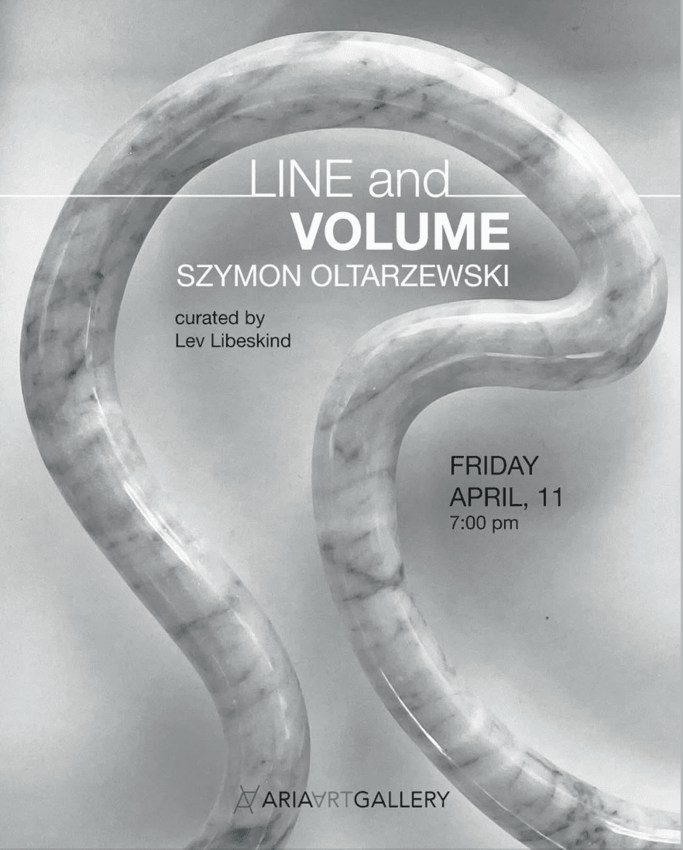
Aria Art Gallery is pleased to present Szymon Oltarzewski’s solo exhibition “Line and Volume,” curated by Lev Libeskind, at its Florence gallery from April 11 to May 10, 2025.
Szymon Oltarzewski’s wall panel series Line and Volume (Linea e Volume) seems at first deceptively simple: a single line or squiggle, like a marble worm, traversing a frame. Yet this simplicity opens up larger questions about the meaning of sculpture, of its dimensionality, and of the peculiar destiny of the line. First, the very framing of these squiggles means that they are meant to be readable as discreet forms: what do they tell us? No doubt there’s a lexical aspect to them, almost like unknown characters of a forgotten alphabet from the farthest island of a distant archipelago (one might compare them to the untranslated Rongorongo petroglyphs of Easter Island.) Yet due to their intrinsic strangeness—their weird twists seem to have a life of their own—each line always exceeds its readability as a “picture” within the frame.
So, we are left with an inscrutably wiggling squiggle with its own contained form, yet which is also part of an imaginary line that extends beyond the frame towards the Infinite. Like a small segment or snippet of an infinite line that connects the whole universe to itself (String Theory comes to mind) we could consider the frame as an attempt to capture, to freeze in marble, the briefest moment of an eternally looping, always twisting and reverberating, universal line or timeline. Second, the series poses a question about two- versus three-dimensional space, or the interdimensional nature of the line between plane and volume—which is perhaps the key question about the nature of sculpture. One may at first be tempted to connect these framed squiggles to the history of bas- and haut-reliefs. However, Oltarzewski’s panels actually represent a break from that tradition: whereas in reliefs the 2D image extrudes into three-dimensionality, the panels do the opposite: they flatten or fold a circuitous 3D cylinder into a two-dimensional frame.
The compression of this cylindrical line—not out of some bendy, lightweight material, but made from marble, sculpture’s hard, classical substance—into two-dimensions implies a certain violence; a force forcing us to rethink, to question, sculpture’s volumetric essence. If Piero Manzoni’s famous Linee series of rolled-up lines of different lengths (as well as his Lines of Infinite Length) represents a compression of the line into a cylinder (the drawing tube) then Oltarzewski’s cylindrical squiggles unroll themselves as wriggling, equally infinite, lines inside rectangles. In Oltarzewski’s stand-alone sculptures, Kiss and Argument, the line—now freed from its frame—begins to take on quasi-facial characteristics. Like a Rorschach inkblot, their suggestive symmetries transmute the line into a wavelength, algorithm, or frequency, between two heads, either kissing or arguing. (Although I prefer to see the two faces in profile as trying to break free from each other in a perhaps vain attempt to become fully 3D.)
Like distant cousins of Osvaldo Cavandoli’s humorous Linea, these two works bend the line into the most basic outlines of the human form. Finally, in Oltarzewski’s two large works, Volto and Greed, volume itself has been liberated from the line altogether; their fluidity expanding into the mucous membranes of space. Horrifically beautiful, dreamlike organs without a body, these auto-dissolving amoebas seem always on the verge of becoming recognizable without ever quite managing to do so. If in Baroque sculpture we can say that the figure is liberated from its marble solidity, then in these works it is the marble itself that struggles to wiggle free from all identifiable figurations. It’s as if the sculptor is aiding and abetting a kind of prison break from recognition, which is why it’s fair to say that Oltarzewski’s work is mainly concerned with thefreedom of Form.
A line as ample as the universe, an infinitely squeezed volume, a solid fluid out of self-digesting stone—or simply…sculpture.